By Ana Paula Blower – Fiocruz News Agency. Published on 22/05/2025
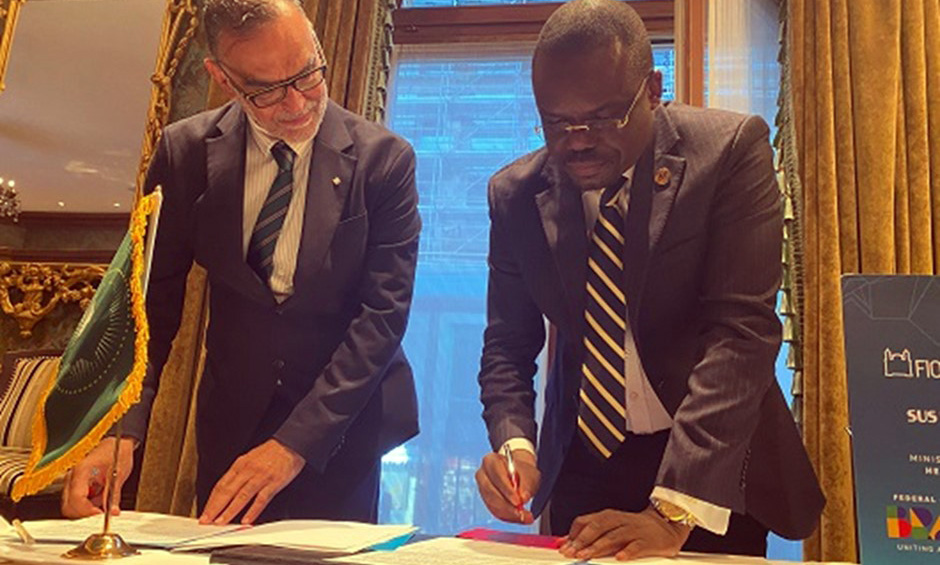
In the very first hours following the creation of the Global Coalition for Local and Regional Production, Innovation and Equitable Access—established by G20 countries on Tuesday morning (20 May)—Brazil launched its first concrete action. This took the form of signing a Memorandum of Understanding (MoU) between Fiocruz and the Africa Centres for Disease Control and Prevention (Africa CDC) to improve health systems across African Union countries. The document was signed during a ceremony celebrating Fiocruz’s 125th anniversary, held alongside the 78th World Health Assembly (WHA) in Geneva, Switzerland.
Guided by the concepts of One Health and the Social Determinants of Health (SDH), the technical and structural cooperation between Fiocruz and Africa CDC aims to foster research and knowledge management, enabling the expansion of local productive capacities for health products and strengthening public health systems in the participating countries, such as Brazil’s Unified Health System (SUS).
The MoU aligns with the objectives of the Global Coalition for Local and Regional Production, Innovation and Equitable Access—an initiative brought to the G20 by the Brazilian government focused on reducing health inequalities. Fiocruz took part in the countries’ accession to the Coalition and has been closely following its development since Brazil’s G20 presidency.
“The Coalition proposal, led by Brazil’s Ministry of Health, speaks directly to the challenges of our time,” said Fiocruz President Mario Moreira. “Fiocruz is proud to contribute, as we have been working in this field for decades. Reducing asymmetries—the Coalition’s core purpose—converges with Fiocruz’s historic struggle to overcome inequalities.”
“Today, as Africans, we are proud to sign this memorandum,” stated Africa CDC Director-General Jean Kaseya. “We have much to gain and will learn a great deal from Fiocruz.”
Valid for three years from the date of signature, the cooperation outlined in the MoU also covers areas such as health economics, social development, and translational policy capacity, in addition to strengthening surveillance and workforce development. Technical and operational working groups will be established, with regular reviews of progress in priority cooperation areas.
Preparatory activities
Preparations for the MoU began in January 2024, with missions by Brazil’s Ministry of Health, the Brazilian Cooperation Agency (ABC/MRE), and Fiocruz to Africa CDC headquarters in Addis Ababa, Ethiopia. Discussions were consolidated in April this year, when an Africa CDC delegation visited Fiocruz to take part in a series of workshops with the Foundation’s researchers. During these meetings, thematic working groups developed a Joint Action Plan (JAP), which forms part of the document signed in Geneva.
The workshops and the MoU fall within the scope of commitments under structural cooperation, through which Fiocruz has played an important role in supporting the strengthening of health systems in Global South countries. Through this collaboration, Fiocruz expands its ongoing contribution to the development of innovative public health solutions.
Fiocruz at the 78th WHA
Continuing its tradition, Fiocruz is participating in the 78th World Health Assembly in Geneva as part of the Brazilian government delegation. Throughout the week, the Foundation is engaging in key discussions and reinforcing its role as a global actor in collective efforts to reduce health inequities. The WHA also marks the start of Fiocruz’s 125th anniversary celebrations, including a ceremony supported by longstanding partners such as the Pasteur Network, the UN Foundation, and Unitaid.
Africa CDC
The Africa Centres for Disease Control and Prevention (Africa CDC) is a public health agency of the African Union (AU), created to support public health initiatives among member states and to strengthen their public health institutions’ capacity to detect, prevent, control, and respond rapidly and effectively to disease threats.
Established in January 2016 during the 26th Ordinary Assembly of Heads of State and Government and officially launched in January 2017, Africa CDC supports AU countries by providing coordinated and integrated solutions for public health infrastructure, workforce training, disease surveillance, laboratory diagnostics, and preparedness and response to health emergencies and disasters.