
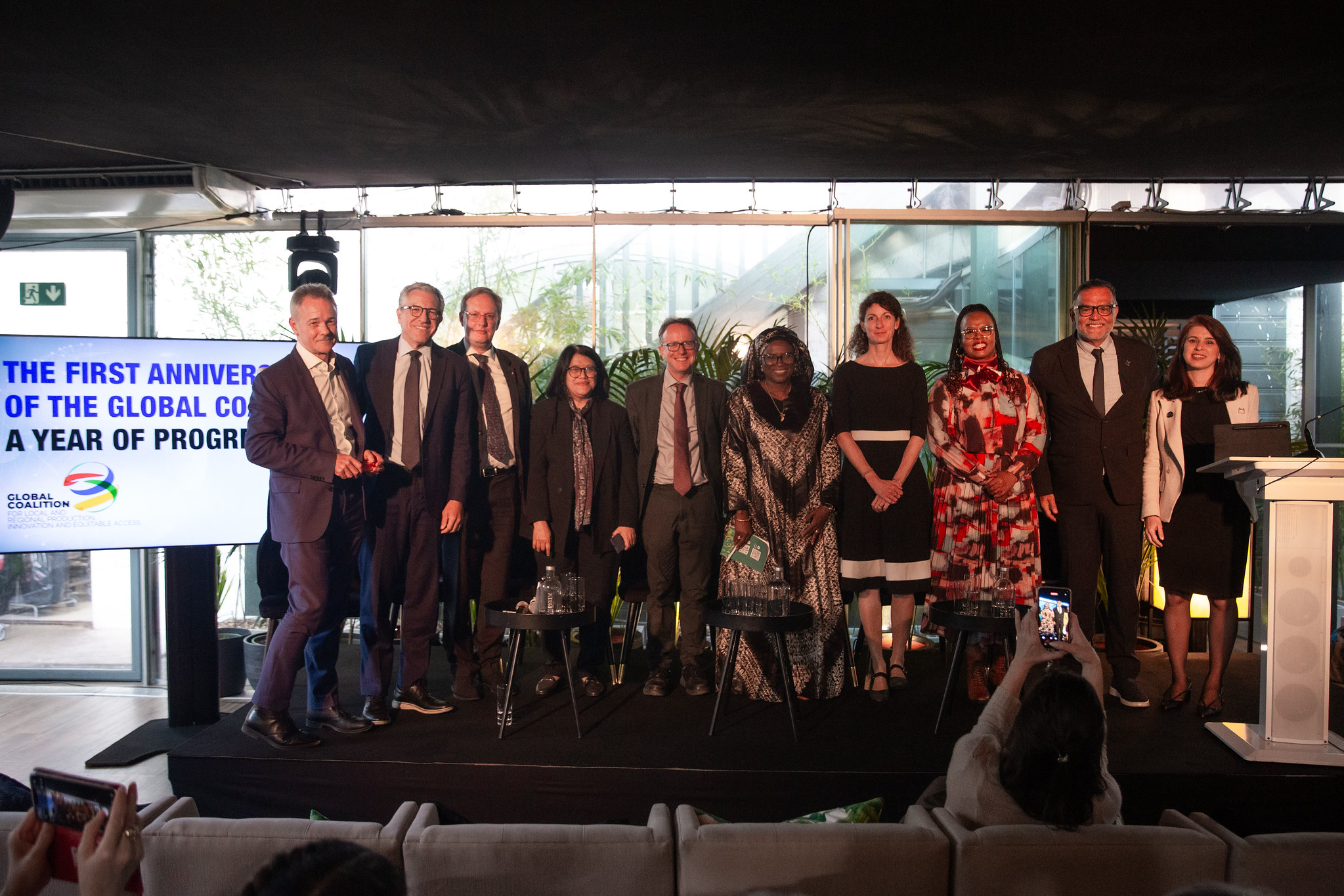
Celebrating its first year of action, the Global Coalition for Local and Regional Production, Innovation and Equitable Access convened members and partners in Geneva to advance equitable health innovation and strengthen local and regional production capacities. The event also welcomed Canada and four international organizations, further expanding the Coalition’s global reach and collaborative network.
On the margins of the 79th World Health Assembly, government representatives, international organizations, research institutions, and global health partners gathered in Geneva to celebrate the first anniversary of the Global Coalition for Local and Regional Production, Innovation and Equitable Access in Health.
Launched under Brazil’s G20 Presidency and supported by Fiocruz as its Executive Secretariat, the Global Coalition was created to strengthen local and regional health production capacities, foster innovation ecosystems, and promote more equitable access to health technologies worldwide.
The anniversary event brought together approximately 140 participants from governments, international organizations, development agencies, academia, civil society, and the private sector.
The event featured remarks by Brazil’s Minister of Health, Alexandre Padilha, an opening address by Fiocruz President Mario Moreira, and moderation by Jeremy Farrar, Assistant Director-General of the World Health Organization (WHO) and Chair of the Coalition’s Advisory Group.
From political commitment to global platform
Throughout the discussions, speakers emphasized that the Coalition represents a long-term effort to address structural inequities in global health by enabling countries – particularly in the Global South – to become producers, developers, and innovators of health technologies rather than remaining solely consumers.
Participants highlighted the importance of strengthening scientific, regulatory, manufacturing, and workforce capacities as part of broader efforts to build resilient and sustainable health systems.

Jeremy Farrar described the Coalition as one of the most significant and concrete outcomes of Brazil’s G20 Presidency, noting its successful transition from a political commitment into an operational platform for collaboration.
He stressed that future progress in global health equity will depend on the development of complete innovation ecosystems and stronger regional capabilities across developing countries.
International support for equitable access
Representatives from France, the United Kingdom, the European Union, Indonesia, South Africa, and the African Union participated in the high-level panel and acknowledged Brazil’s leadership in advancing the initiative from conception to implementation.
Additional contributions were made by Rebecca Grais, Executive Director of the Pasteur Network; Luis Pizarro, Executive Director of the Drugs for Neglected Diseases initiative (DNDi); Rajinder Suri, Chief Executive Officer of the Developing Countries Vaccine Manufacturers Network (DCVMN); Aurélia Nguyen, Deputy Chief Executive Officer of the Coalition for Epidemic Preparedness Innovations (CEPI); Tenu Avafia, Deputy Executive Director of Unitaid; Ines Hassan, Head of Secretariat of the International Pandemic Preparedness Secretariat (IPPS); Kerri Elgar, Senior Global Health Advisor at the Organisation for Economic Co-operation and Development (OECD); Viviana Muñoz, Programme Coordinator of the Health, Intellectual Property and Biodiversity Programme at the South Centre; Jaime Atienza, Director of Sustainability at UNAIDS; Esteban Burrone, Director of Policy, Strategy and Market Access at the Medicines Patent Pool (MPP); Pierre Hugo, Vice-President for Access and Product Management at Medicines for Malaria Venture (MMV); and Monica Rull, Interim Executive Director and Deputy Executive Director of Médecins Sans Frontières (MSF) Access.
Discussions underscored the importance of regional manufacturing, technology transfer, pooled procurement mechanisms, and South-South cooperation in improving access to health products and reducing vulnerabilities in global supply chains.
A broad range of international organizations and partnerships also expressed support for the Coalition, including CEPI, DNDi, FIND, the International Vaccine Institute (IVI), the Medicines Patent Pool (MPP), the Organisation for Economic Co-operation and Development (OECD), UNAIDS, Unitaid, and Médecins Sans Frontières (MSF), among others.
Participants highlighted the Coalition’s unique approach to linking local production, equitable access, international coordination, and sustainable development objectives.
Expanding the Coalition’s global reach
The event also reflected the Coalition’s growing international reach.
Attendees included representatives from Brazil, Canada, China, France, Germany, Indonesia, Italy, South Africa, Barbados, the African Union, the European Commission, WHO, PAHO, UNAIDS, UNIDO, WIPO, WTO, Gavi, the Global Fund, the Pandemic Fund, Health Canada, Afrigen, the Developing Countries Vaccine Manufacturers Network (DCVMN), the Regionalised Vaccine Manufacturing Collaborative (RVMC), and numerous academic and civil society institutions.
During the event, Minister Padilha announced the accession of Canada and four international organizations to the Coalition: the Pan American Health Organization (PAHO), Medicines for Malaria Venture (MMV), the Medicines Patent Pool (MPP), and the South Centre.

Their inclusion further expands the Coalition’s international reach and strengthens its growing network of governments, multilateral organizations, research institutions, and global health partners committed to advancing local and regional production, innovation, and equitable access to health technologies.
From dialogue to action
Another milestone highlighted during the meeting was the launch of the Coalition’s first call for proposals, focused on dengue.
The initiative was presented as a practical demonstration of the Coalition’s commitment to addressing pressing global health challenges through collaborative innovation, local production, and equitable access to health technologies.
As the Coalition enters its second year, participants reaffirmed their commitment to advancing a more balanced and resilient global health architecture – one in which innovation, production capacity, and access are shared more equitably across regions and countries.