
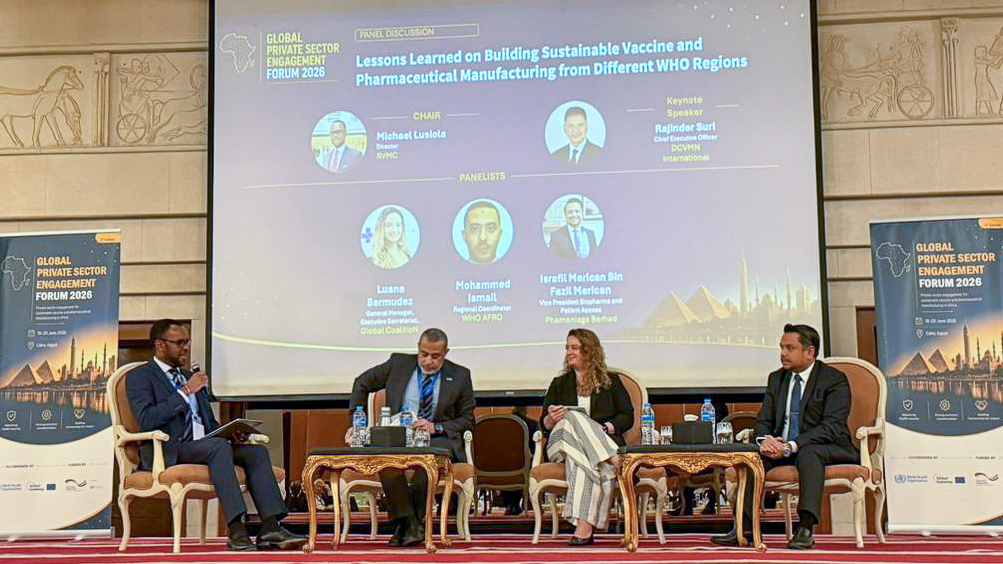
Stronger cooperation among regions, countries and institutions is essential to move from manufacturing ambition to sustainable health production and equitable access to health technologies, the Global Coalition for Local and Regional Production, Innovation and Equitable Access said on 19 June.
During the 3rd Global Private Sector Engagement Forum (PSEF2026) in Cairo, Egypt, Luana Bermudez, General Manager of the Global Coalition, highlighted the need to connect global commitments with practical implementation and strengthen local and regional production capacities.
Speaking on a panel on lessons learned from building sustainable vaccine and pharmaceutical manufacturing across different WHO regions, Dr. Bermudez highlighted the importance of strengthening local and regional production, innovation and equitable access to health technologies, particularly in developing countries.
She stressed that health should be understood as a core component of development strategies, requiring investments in productive, scientific and technological capacities that can support resilient health systems and expand access to vaccines, therapeutics, diagnostics and other essential health technologies.
Bermudez also emphasized the need for more structured mechanisms to connect countries, institutions and partners across regions, helping to reduce fragmentation, share experiences and accelerate implementation.
She noted that this is precisely where the Global Coalition seeks to add value by strengthening coherence, reducing duplication and supporting more aligned action across regions.
“What is needed is a more structured and systematic approach to knowledge and experience-sharing across regions, one that helps connect these individual experiences into a broader ecosystem of learning and implementation,” said Dr. Bermudez.
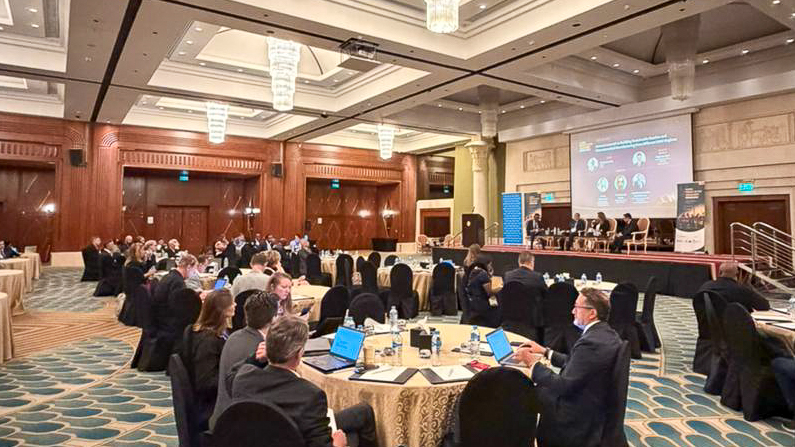
Photo: Global Coalition for Local and Regional Production, Innovation and Equitable Access
The session, Lessons Learned from Different WHO Regions in Building Sustainable Vaccine Manufacturing, was chaired by Michael Lusiola of the Regionalized Vaccine Manufacturing Collaborative (RVMC), a member of the Global Coalition’s Advisory Committee.
The discussion brought together perspectives from Africa, Asia and Latin America on how to create enabling ecosystems for sustainable regional manufacturing, with a particular focus on demand, markets and long-term sustainability.
Rajinder Suri of the Developing Countries Vaccine Manufacturers Network (DCVMN), also a member of the Coalition’s Advisory Committee, delivered the keynote address, sharing lessons from DCVMN members’ experience on making local vaccine manufacturing viable over the long term.
Other speakers included Dr. Mohamed Ismail of WHO Regional Office for Africa (WHO AFRO) and Dr. Israfil Merican of Pharmaniaga, Malaysia, who exchanged views on cross-regional learning, market sustainability and strengthening manufacturing ecosystems across WHO regions.
Global Call for Proposals on Dengue
The Global Coalition is currently accepting submissions for its first Global Call for Proposals on Dengue, which seeks to support collaborative initiatives that strengthen local and regional capacities for research, development, production and access.
The deadline for submissions is 31 July 2026 (10 p.m. GMT). Learn more: https://globalcoalitionforlocalproduction.org/projects.
About the Global Coalition
The Coalition is one of the most important outcomes of Brazil’s G20 Presidency.
The signing of the Geneva Charter on May 20, 2025 – during the 78th World Health Assembly – which officially established the Global Coalition for Local and Regional Production, Innovation and Equitable Access, was a key milestone in bringing forward urgent issues that address several interconnected challenges.
These include the concentration of scientific capacity, research and development (R&D), and production in the life sciences, technology, and health sectors in a small number of countries; fragile supply chains; regulatory asymmetries; and the limited integration between innovation, production, and access, particularly in low- and middle-income countries.
The initiative emerges within this context and from a commitment to addressing health inequities exacerbated by the COVID-19 pandemic.
It advances a new model for the production of and access to essential health technologies – such as vaccines, therapies, and diagnostics – particularly for neglected diseases and populations living in vulnerable conditions globally, especially in Latin America, the Caribbean, and other developing regions.
The Coalition is led by the Ministry of Health of Brazil, with the Executive Secretariat hosted by Fiocruz.