By Ministry of Health of Brazil and Oswaldo Cruz Foundation (Fiocruz)
Strengthening local and regional production of health products, promoting technological innovation, and reducing global inequalities in access to health. These are the objectives of the first call for proposals of the Global Coalition for Local and Regional Production, Innovation and Equitable Access.
The initiative was launched on Tuesday (24/3) at Fiocruz and focuses on projects related to tackling dengue. The call represents the progress of the Coalition, one of the main legacies of Brazil’s G20 presidency, led by the Ministry of Health with the executive secretariat hosted by Fiocruz.
The call for proposals seeks to identify and support projects that foster the structuring of sustainable global networks that ensure essential technologies (such as vaccines, therapies, and diagnostics) for neglected diseases and persons living in vulnerable conditions.
Minister of Health, Alexandre Padilha, attended the opening session of the event. “The first challenge to be addressed (within the scope of the Coalition) was defined jointly by the Steering Committee: dengue. Currently, about half of the world’s population is at risk of contracting the disease, with nearly 400 million infections per year, present on all continents,” he emphasized.
According to the minister, this moment represents progress in tackling dengue in Brazil and worldwide. “We are betting on cooperation, dialogue, and science to promote joint development. We believe in a world with fewer conflicts and greater access to vaccines, medicines, and life. With the launch of the Coalition’s first call for proposals, the idea is to reduce the impacts of failures in the supply of health inputs, especially in countries of the Global South,” said Padilha.
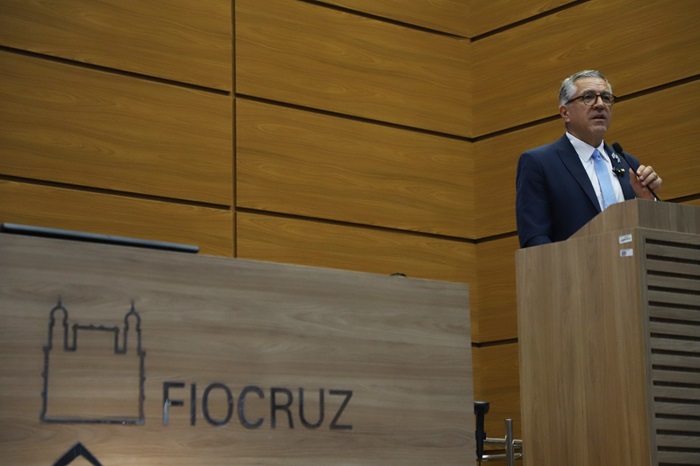
According to Padilha, the first challenge to be addressed is dengue (photo: Peter Ilicciev/Fiocruz)
Assistant Director-General of the World Health Organization (WHO) for Health Promotion, Disease Prevention and Care, Jeremy Farrar, who is also Chair of the Coalition’s Advisory Committee, attended the launch in person and highlighted the importance of leadership in “such uncertain times.” He also pointed out several challenges currently faced globally, such as inequities, conflicts, and climate change.
“This call for proposals reflects a collective commitment to science, Research & Development, and equity in health, strengthening regional production, promoting innovative technologies for priority diseases, and enabling scientific and economic growth in a sustainable manner,” stated Farrar.
For the President of Fiocruz and Executive Secretary of the Coalition, Mario Moreira, the call represents a milestone in the development of the initiative. “We have been working to ensure that the Coalition materializes as a platform in which governments, multilateral organizations, producers, civil society, technical institutions, and regional bodies can move forward together, aligned in purpose and guided by equity,” he highlighted.
Moreira recalled the creation of the Coalition and the designation of Fiocruz as executive secretariat, emphasizing that the initiative was conceived by G20 Health Ministers and voluntarily supported by governments, international organizations, the private sector, public and philanthropic institutions, academia, and civil society.
“We receive this responsibility with great honor, but also with full awareness of its importance,” he said. “We see the Coalition not only as a mandate, but as an opportunity for greater unity and responsibility, and for stronger articulation among the various strategies, platforms, and initiatives existing across different regions.”
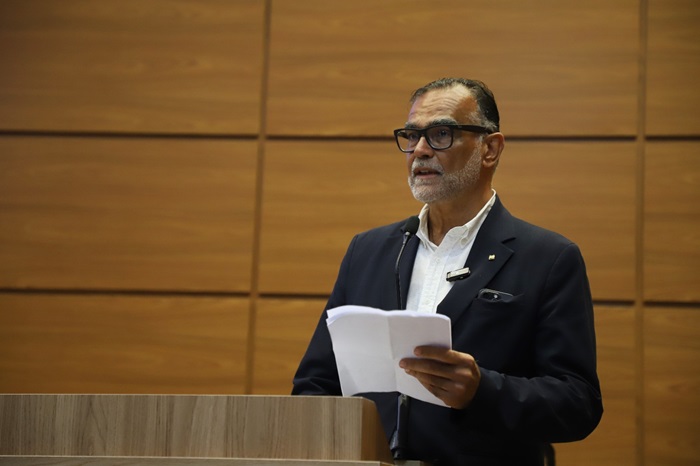
For Mario Moreira, the call represents a milestone in the development of the initiative (photo: Peter Ilicciev)
After the opening ceremony, Fiocruz Vice President for Production and Health Innovation, Priscila Ferraz, joined a panel that provided an overview of the Coalition and an analysis of the call for proposals. “A key word is access. When we think about access, it is not enough to think only about development, but about the entire chain for that product, or that health technology, to reach those who truly need it,” observed Ferraz.
“We are encouraging, by the very nature of the Coalition, that proposals also be submitted in consortium format, that we have public-private partnerships, partnerships that are not only within countries but within regions, so that we can, in fact, accelerate the process of expanding research, development, innovation, and production capacity.”
The Head of the Special Advisory Office for International Affairs of the Ministry of Health, Marise Nogueira, also participated in the panel, bringing contributions on the initiative and its role.
Director of the Institute of Immunobiological Technology (Bio-Manguinhos/Fiocruz), Rosane Cuber moderated a panel on how other initiatives can contribute to the Coalition’s objectives. Participants included the Secretary of Science, Technology and Innovation in Health of the Ministry of Health, Fernanda de Negri; the Head of the Office for Health Policy and International Relations of the Ministry of Health of France, Bertrand Millet; the Representative in Brazil of the Pan American Health Organization (PAHO/WHO), Cristian Morales; and the Director General of the International Vaccine Institute (IVI), Jerome Kim.
Cuber pointed out the need to create synergies: “The challenge of the Coalition is to ensure that initiatives are strategically articulated with the existing ecosystem. By acting in a coordinated manner, the initiative will expand its impact and achieve its objective of making countries sovereign and meeting the needs of the most vulnerable populations,” she commented.
Equitable access to health technologies
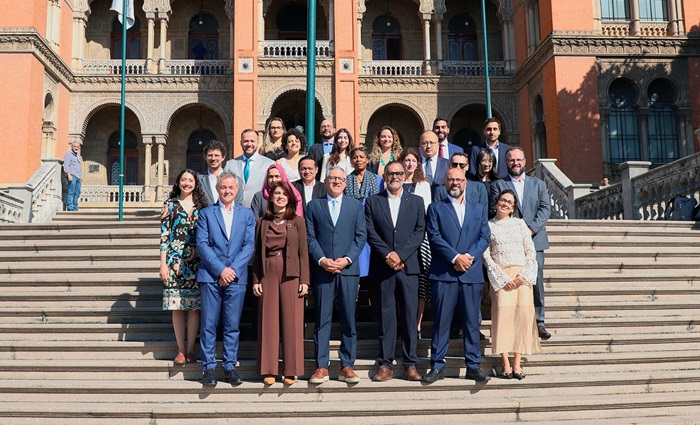
Members of the Coalition’s Steering and Advisory Committees met in person for the first time on Tuesday morning (24/3), at Fiocruz.
On the occasion, they discussed operational topics, such as the call for proposals. With a focus on identifying high-impact projects that address situations of inequity, the call seeks proposals that meet local, national, or regional needs, including multinational initiatives and, where applicable, with potential for replication or adaptation in other contexts.
By promoting the strengthening of local and regional capacities and international cooperation, the call aims to contribute to making health technologies more accessible, available, and aligned with public health needs, advancing the reduction of global inequalities.
Governments, international organizations, private and public institutions, and non-profit organizations may apply. More information is available on the Coalition’s website.
About the Global Coalition
The Global Coalition for Local and Regional Production, Innovation and Equitable Access was established with the signing of the Geneva Charter on May 20, 2025, during the 78th World Health Assembly.
Its objective is to bring to the forefront emerging issues and interconnected challenges: the concentration of science, research and development (R&D), and production capacity in the life sciences, technology, and health sectors in a small number of countries; fragile supply chains; regulatory asymmetries; and limited integration between innovation, production, and access, particularly in low- and middle-income countries.
The initiative arises from a commitment to overcoming health inequities exacerbated during the COVID-19 pandemic, advancing a proposal for a new model of production and access to innovation for essential health technologies, such as vaccines, therapies, and diagnostics for neglected diseases and people living in vulnerable conditions.